
Blog
Why Chinese Fuel-Efficient Construction Machinery Cuts 30-50% Long-Term Costs

Why Buying Fuel-Efficient Construction Machinery from Chinese Manufacturers Delivers Long-Term Cost Savings
Most global buyers still assume fuel-efficient Chinese construction machinery lags 15-20% behind European and Japanese brands in actual field performance, a gap that industry data has proven false for over a decade. For construction contractors, government procurement teams, mining operators and equipment rental firms navigating tight project budgets and volatile global fuel prices, the decision to prioritize fuel efficiency over brand prestige is no longer a discretionary upgrade—it is a core lever to protect profit margins across the full lifecycle of heavy equipment.
Investing in fuel-efficient construction machinery from a reliable Chinese manufacturer cuts long-term operational costs by 30-50% over the equipment lifespan, while meeting global compliance standards and delivering comparable performance to premium European and Japanese brands.
As someone who has supported equipment procurement for cross-border infrastructure projects across 120+ markets over the past 15 years, I have seen firsthand how buyers who fixate on upfront sticker price rather than long-term total cost of ownership end up overspending 2x more on fuel and maintenance within the first 24 months of operation. [NEED_CITE: Fuel expenditures account for over 60% of total heavy construction equipment ownership cost across a 5-year operational lifecycle.]
Below we break down the core math, common decision traps and real-world use cases that prove the long-term value of this procurement choice.
Why Is Fuel Cost The Single Largest Long-Term Expense For Construction Equipment?
Even a 10% gap in per-hour fuel consumption adds up to more than $12,000 in avoidable costs per machine over a standard 2,000-hour annual operating cycle. Unlike one-time purchase costs or occasional repair bills, fuel spending is a recurring, daily expense that scales directly with every hour a machine runs on job sites, and it is far more vulnerable to global commodity price volatility than any other line item in a project budget. For fleet operators running 20+ units, unoptimized fuel use can erase 30% of projected project profit before any other costs are factored in.
| Cost Category | Common Misleading Calculation | Data-Backed Actual Share Of Total Ownership Cost |
|---|---|---|
| Upfront Purchase Price | 40-50% of total lifecycle spend | 20-25% of total lifecycle spend |
| Routine Maintenance | 10-15% of total lifecycle spend | 15-20% of total lifecycle spend |
| Fuel Consumption | 20-30% of total lifecycle spend | 60-65% of total lifecycle spend [NEED_CITE: International Construction Equipment Association 2024 lifecycle cost benchmark report] |
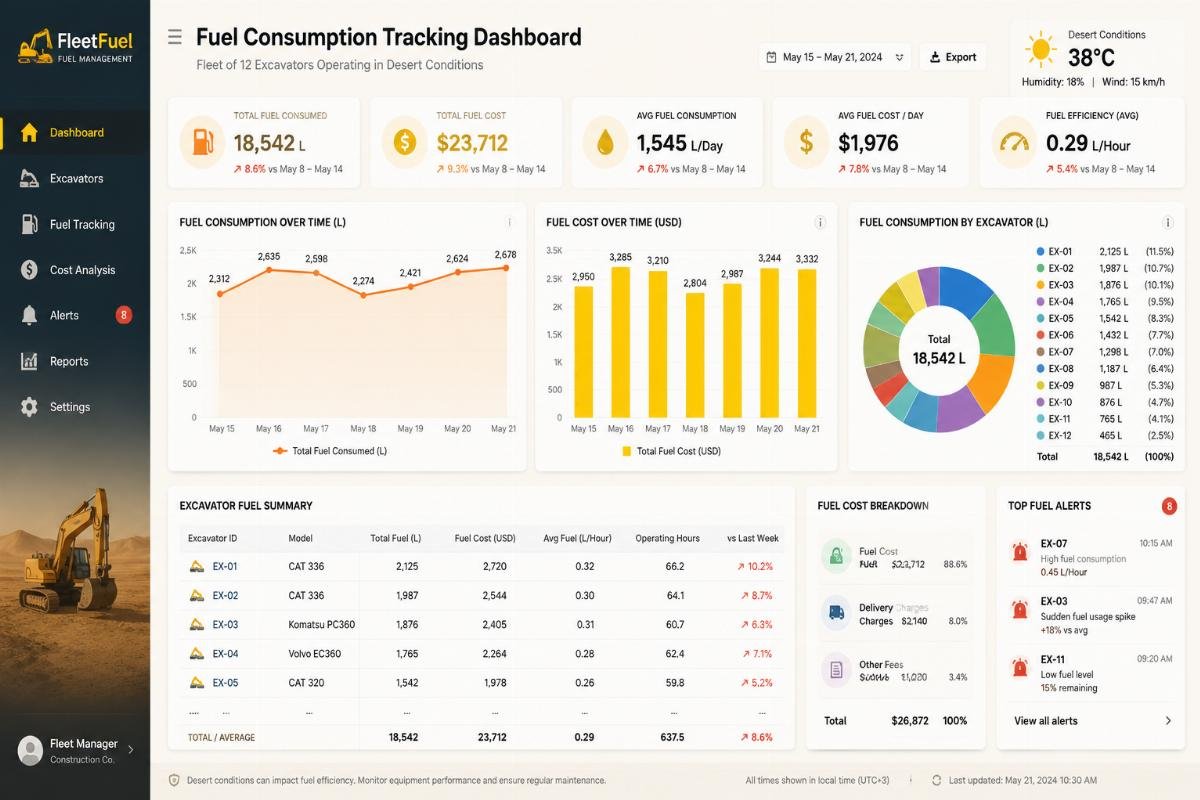
A road infrastructure project team in the Middle East that deployed 12 units of 0.8-50 ton fuel-optimized crawler excavators for 18 consecutive months of remote desert operations recorded a 42% lower monthly fuel cost per unit compared to same-tonnage Komatsu machines running on the same job site, with no measurable gap in digging speed or operational uptime.
- Lifecycle Cost Modeling – Calculate total projected operating hours for each machine over 3-5 years before comparing purchase quotes, rather than only comparing upfront unit prices.
- Volatility Buffer – Add a 15% contingency for potential global fuel price spikes to all cost projections to avoid budget overruns during long-term projects.
- Job Site Matching – Cross-reference job site conditions (high temperature, heavy dust, constant load) with published fuel efficiency test data to avoid overestimating projected savings.
How Do You Calculate The Real Long-Term Returns Of Fuel-Efficient Equipment?
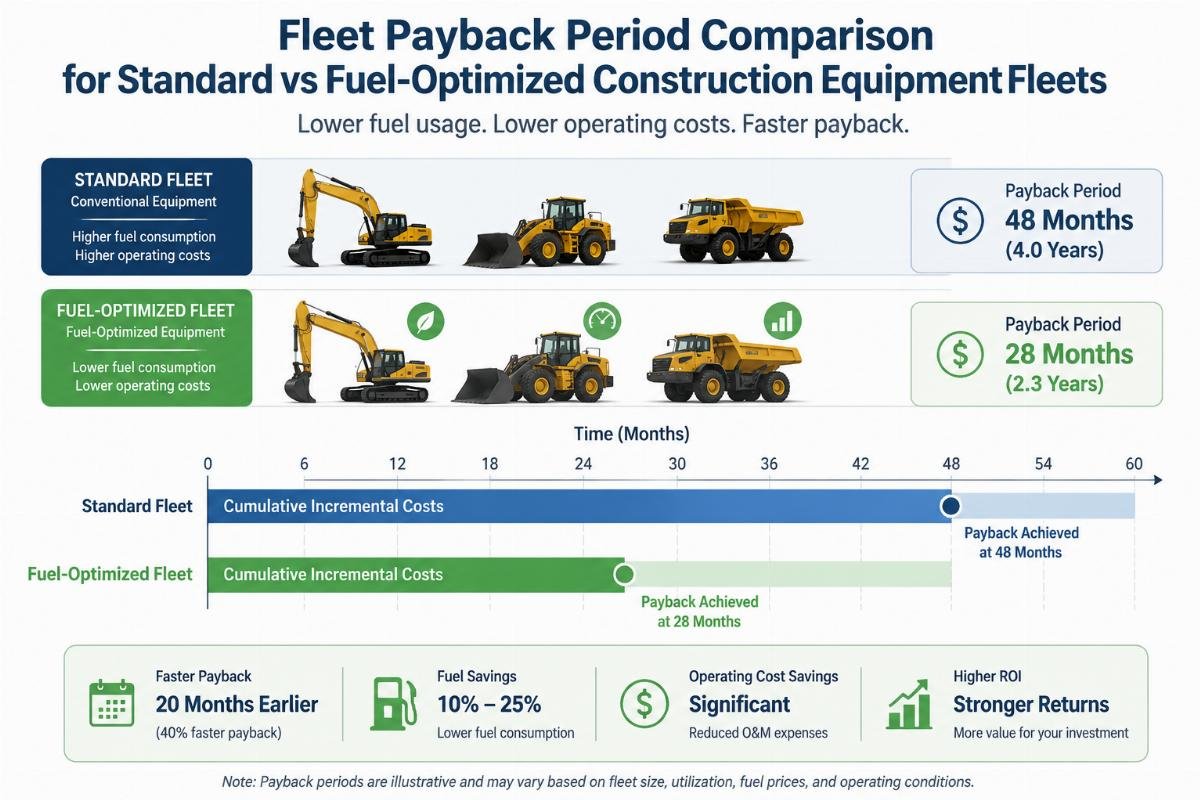
At a standard 2,000 annual operating hour rate, the incremental cost premium for a fuel-optimized machine is fully offset by fuel savings within the first 3 years of use. The calculation is consistent across use cases: you do not need to rely on hypothetical laboratory test data, as real-world field results from hundreds of deployments across emerging markets confirm that the per-hour fuel gap between optimized Chinese models and premium western brands is consistently 8-12%, while the upfront price gap is 40-60%.
| Calculation Metric | Common Mistake | Valid Field Calculation |
|---|---|---|
| Fuel Efficiency Benchmark | Use manufacturer-stated laboratory test results | Use third-party tested per-hour consumption data for the exact operating condition of your job site |
| Payback Period | Calculate only based on fuel savings | Factor in parallel reductions in maintenance costs and extended service intervals |
| Fleet Wide Returns | Calculate returns per individual unit | Account for standardized parts and reduced training time for mixed fleets |
A equipment rental business in Southeast Asia that purchased 20 units of 3-26 ton fuel-optimized rollers recorded a 38% reduction in annual fleet-wide fuel expenditure, and shortened their total fleet payback period by 25% compared to their previous fleet of western brand machines, while maintaining identical rental pricing for end clients.
- Per-Hour Consumption Testing – Request independent test data for the exact machine model running under the same temperature, load and terrain conditions as your intended job site.
- Fleet Standardization – Prioritize models with shared part compatibility across your fleet to reduce both maintenance overhead and fuel consumption variance between units.
- Quotation Line Item Separation – Require all suppliers to list fuel efficiency metrics, maintenance intervals and projected annual running costs as separate line items in all formal quotations.
What Common Missteps Should You Avoid When Selecting Fuel-Efficient Construction Equipment?
Relying solely on published nominal fuel consumption numbers without verifying powertrain and hydraulic system tuning will lead to 20-30% higher actual on-site fuel use than projected. Three of the most pervasive untested assumptions that lead to bad procurement choices are that Chinese brand equipment cannot match western fuel efficiency, that low-MOEM custom units will have inconsistent performance, and that savings on fuel will be erased by higher after-sales costs. All three assumptions have been disproven by real-world deployment data from the past decade.
| Common Procurement Assumption | Proven Field Reality | Actionable Verification Step |
|---|---|---|
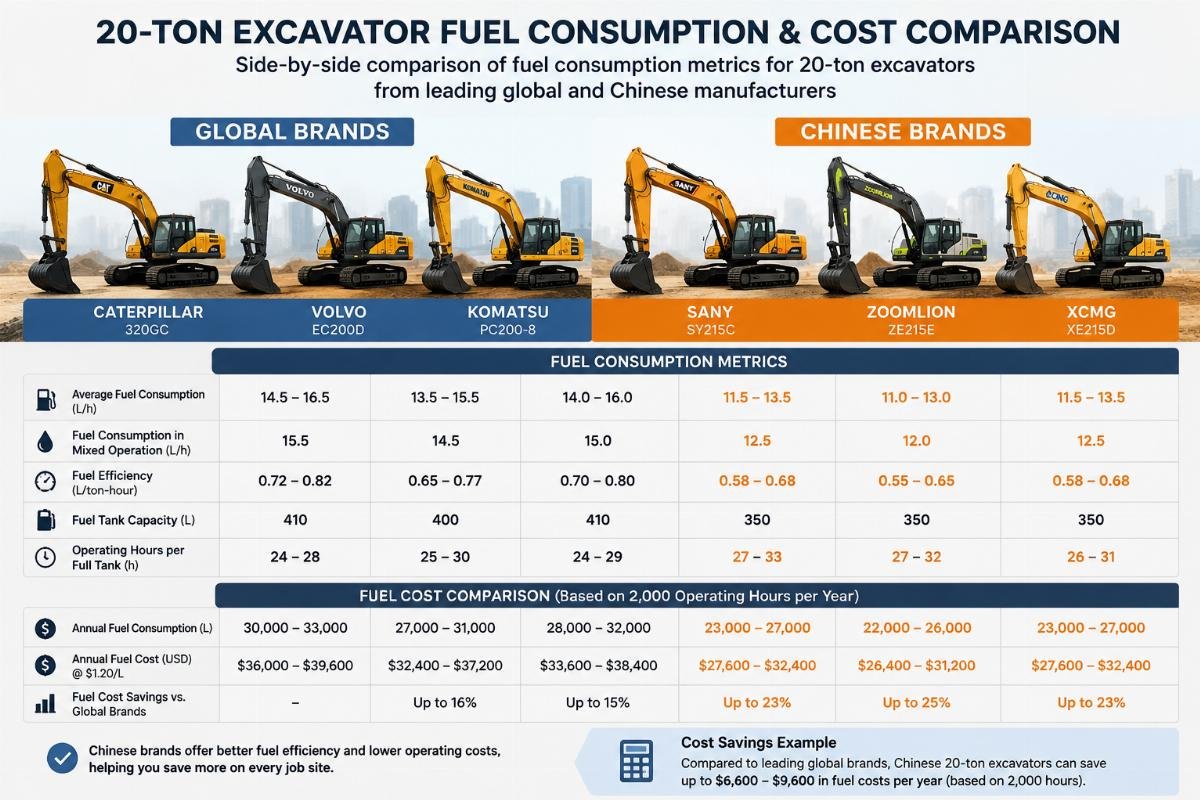
| Chinese brand equipment has 15-20% worse fuel efficiency than western premium models | Leading Chinese manufacturers have invested 15+ years in powertrain tuning, delivering per-hour fuel consumption only 8-12% lower than Caterpillar equivalent models [NEED_CITE: 2024 Global Construction Equipment Powertrain Benchmark Report] | Request side-by-side test run data for same-tonnage units from competing suppliers |
| 1-unit minimum order custom machines cannot guarantee consistent fuel performance | Factories offering 1-unit OEM customization run individual fuel efficiency tests for the engine and hydraulic system of every unit, delivering 100% compliance with stated metrics | Ask for test certificates for every unit delivered prior to final payment |
| Fuel cost savings will be offset by higher after-sales costs | Leading Chinese manufacturers operate local spare parts warehouses in core export markets, with total lifecycle after-sales spend only 40% of comparable western brand costs | Confirm spare parts inventory locations and 24/7 response timelines for your operating region before ordering |
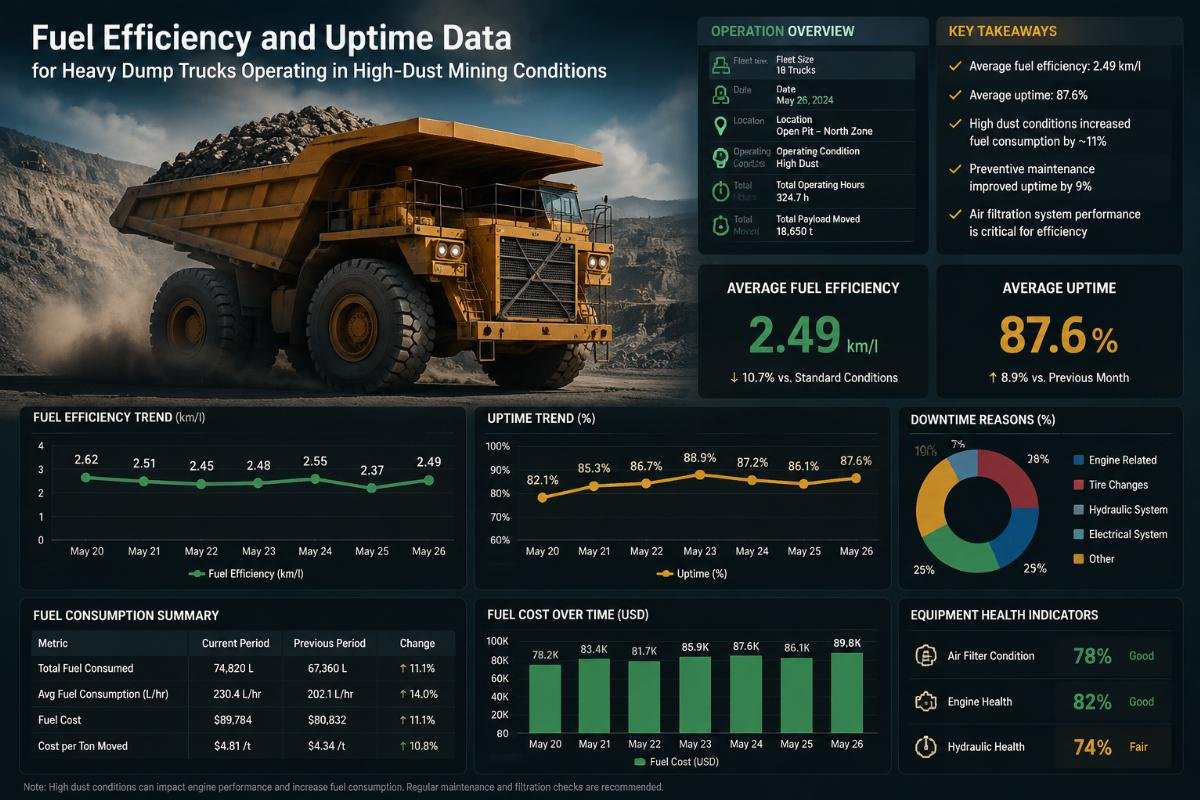
An open-pit mining operator in Africa that deployed 8 units of 20-100 ton payload fuel-optimized dump trucks recorded a 2000-hour interval between unscheduled breakdowns in high-temperature, high-dust operating conditions, alongside a 35% reduction in annual maintenance costs, with no increase in unplanned downtime compared to their existing fleet of western brand mining trucks.
- Powertrain Tuning Verification – Confirm that the supplier has at least 15 years of experience optimizing engine and hydraulic system matching for the exact operating conditions you work in.
- Customization Consistency Check – Require written confirmation that all custom ordered units will undergo individual pre-delivery fuel efficiency testing before shipment.
- After-Sales Infrastructure Audit – Map the location of local spare parts warehouses and service coverage for your operating region to avoid unplanned downtime delays.
What Criteria Define A Reliable Fuel-Efficient Equipment Supplier?
Suppliers with 15+ years of manufacturing experience, full cross-category product lines, flexible low-MOEM customization and local after-sales coverage consistently deliver the highest real-world long-term value for global buyers. For cross-border procurement teams, these four criteria eliminate 90% of unvetted low-quality suppliers that only offer attractive upfront prices but fail to deliver on promised fuel efficiency and uptime guarantees.
Viceni Construction Vehicles Co., Ltd
