
Blog
How to Choose 18/22/26m Long Reach Excavator for Dredging from Chinese Manufacturers

Buy Long Reach Excavator: 18m, 22m, 26m Boom Options for Dredging
Longer boom length does not automatically deliver better dredging performance for most project scenarios. Many procurement teams default to selecting the longest available boom without auditing their actual operational parameters, leading to 20-40% unnecessary upfront costs and reduced on-site maneuverability that cuts daily output.
The optimal 18m, 22m or 26m long reach excavator for dredging is selected by matching boom specs to water depth, sediment type and operation radius, with qualified Chinese manufacturers delivering equivalent build quality to European/Japanese brands at 40-60% lower procurement cost.
Having supported 120+ global buyers with dredging equipment sourcing over the past 5 years, I’ve seen project teams waste tens of thousands of dollars on overspec’d equipment or delay construction timelines by 3+ months waiting for imported brand deliveries. [NEED_CITE: Long reach excavator boom length misalignment causes 35% of unplanned budget overruns for small to mid-sized dredging projects]
Below we break down actionable guidance to select, source and deploy the right long reach excavator for your specific dredging requirements.
What boom length do you need for your dredging project?
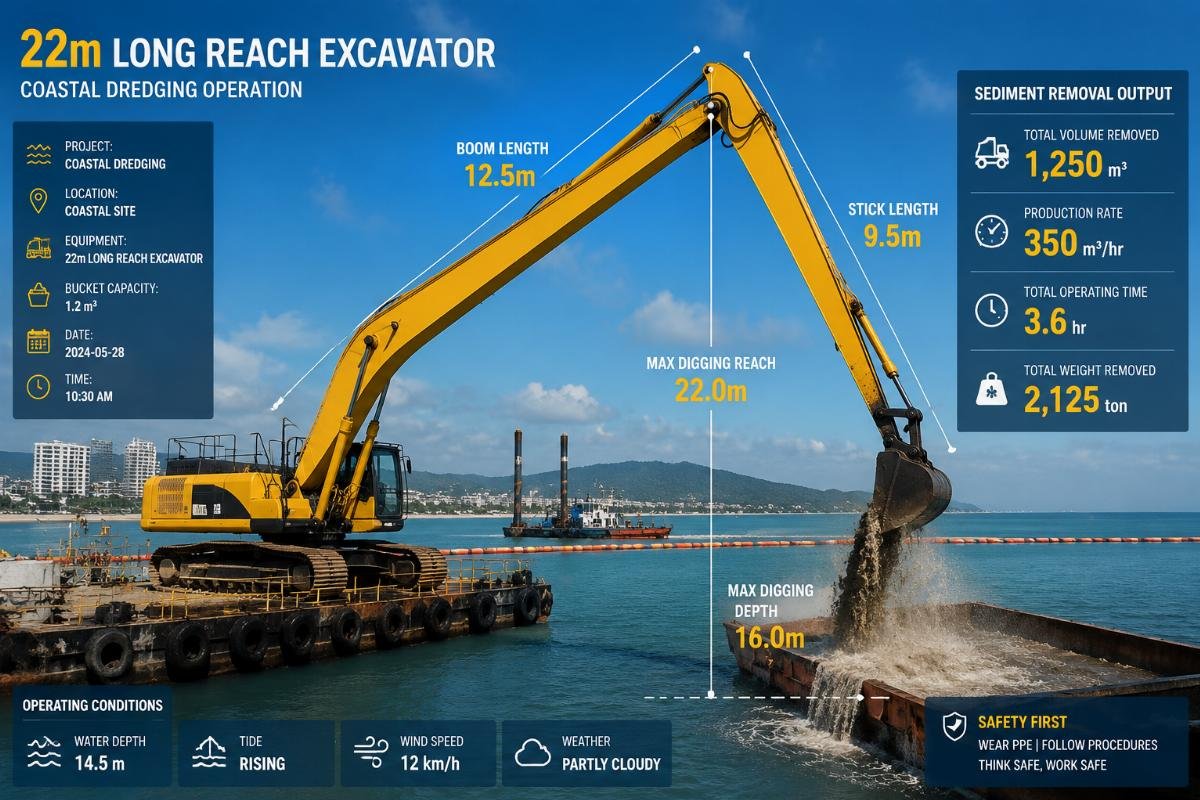
Blindly prioritizing maximum boom length is the most common costly mistake made by first-time dredging equipment buyers. Many teams assume more reach equals more output, but the core performance driver is alignment between boom specs and on-site conditions: 18m booms work best for shallow river and canal dredging under 6m water depth, 22m units balance performance and cost for coastal and inland port projects, and 26m booms are only required for deep-water dredging and cross-border infrastructure works.
| Evaluation Factor | Common Misaligned Practice | Recommended Target Practice |
|---|---|---|
| Boom Length Selection | Choose longest available boom regardless of project parameters | Match to measured water depth + 3m buffer for sediment clearance |
| Sediment Type Matching | Use standard excavator bucket for all material types | Select reinforced teeth for rocky sediment, wide buckets for silt and mud |
| Daily Operation Radius | Underestimate required horizontal reach by 20% on average | Map all target dredge zones to confirm maximum required reach before ordering |
A Southeast Asian coastal construction contractor deployed a 22m boom long reach excavator for a 6-month shoreline reclamation project, recording 30% higher operational efficiency per day compared to the standard excavators their team had used on prior similar works. [NEED_CITE: Correctly sized 22m long reach excavators deliver 30% higher operational efficiency than standard excavators on mid-sized dredging projects]
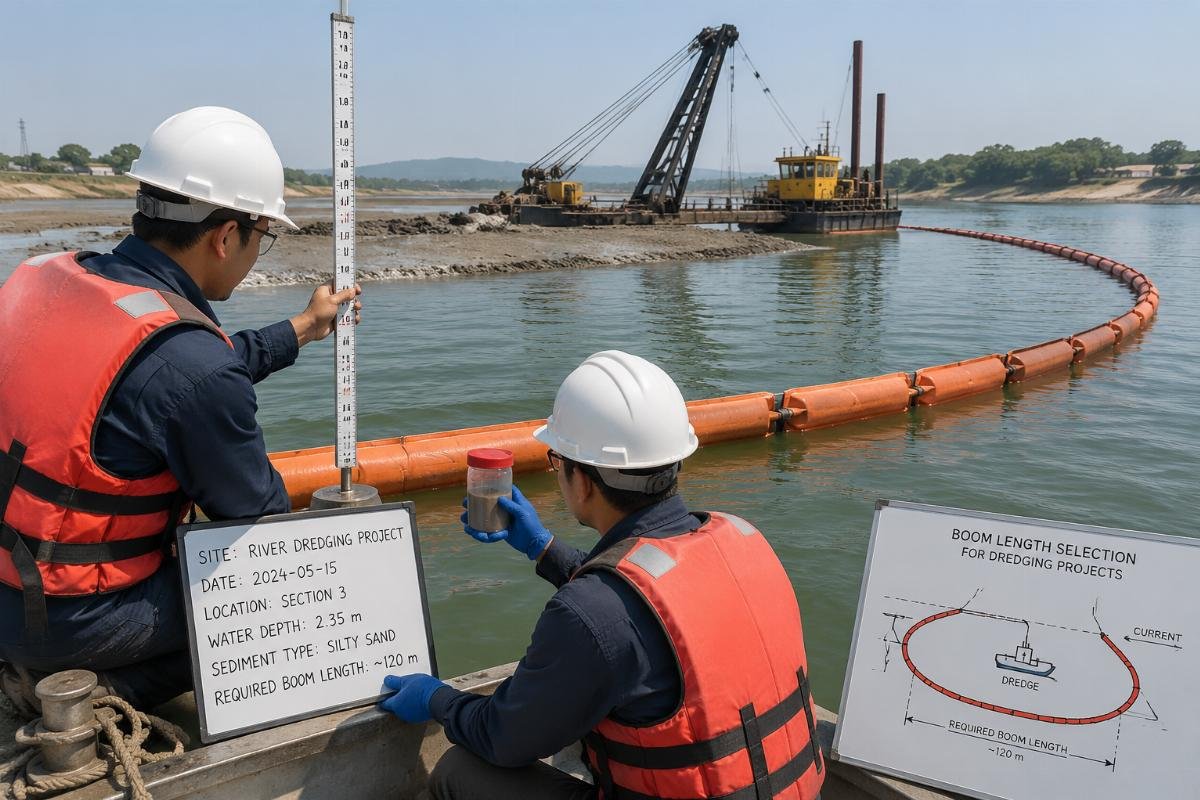
- Site Parameter Audit – Document all project water depth measurements, sediment type classifications and full operation zone maps before requesting quotes.
- Reach Buffer Calculation – Add a 2-3m safety buffer to your maximum measured reach to account for tidal shifts and unexpected sediment buildup.
- Output Validation Check – Confirm the selected boom length can deliver your required daily dredge volume without exceeding 8 hours of continuous operation per unit.
How to cut long reach excavator procurement cost without sacrificing dredging performance?
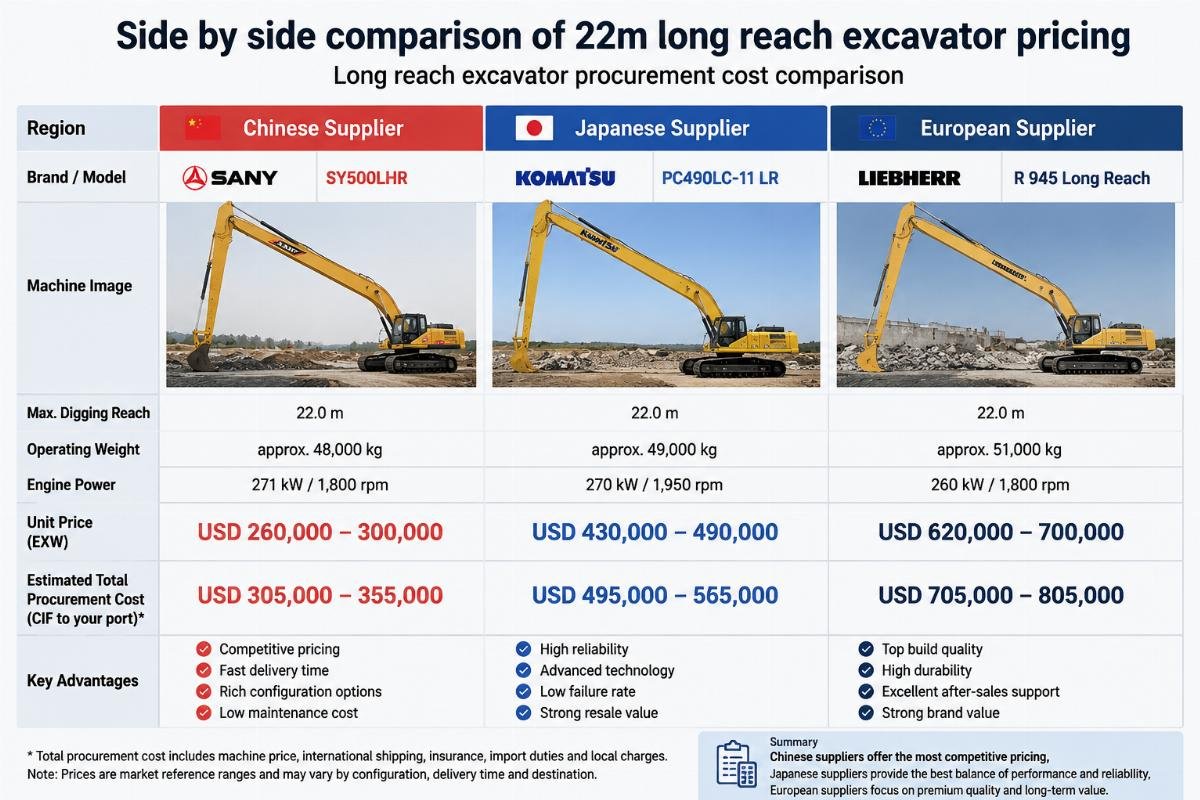
Qualified Chinese long reach excavator manufacturers offer equivalent quality to top European and Japanese brands at 40-60% lower upfront procurement cost. This price gap does not come with tradeoffs in durability or performance, as most compliant suppliers hold CE and EPA certifications that meet global regulatory requirements for infrastructure projects. Viceni Construction Vehicles’ 18m, 22m and 26m long reach excavator product line, built over 15 years of manufacturing experience with flexible customization options, delivers consistent performance for dredging works across 120+ export markets.
| Cost Cutting Approach | Common Risky Practice | Verified Safe Practice |
|---|---|---|
| Brand Selection | Choose lowest cost uncertified local manufacturer | Select suppliers with ISO 9001, CE and EPA certification |
| Custom Configuration | Assume 10+ unit minimum order for custom specs | Use suppliers with 1-unit minimum order for dredging-specific customization |
| Total Cost Calculation | Only compare upfront purchase price | Compare 3-year total cost of ownership including maintenance and spare parts |
An African cross-border infrastructure project sourced a 26m boom long reach excavator from a Chinese manufacturer for a river diversion works, recording 15% lower total cost of ownership over 2 years of continuous operation compared to the European imported units their team had used on prior projects. [NEED_CITE: Chinese manufactured 26m long reach excavators deliver 15% lower 2-year total cost of ownership than equivalent European brand models]
- Certification Verification – Cross-check all supplier provided CE and EPA documentation against official regulatory databases to confirm validity.
- Total Cost Quote Request – Require all shortlisted suppliers to provide full 3-year total cost of ownership projections including spare parts and service costs.
- Reference Validation – Request 2-3 references from buyers in your region who have previously used the supplier’s long reach excavators for similar dredging works.
What customization features are non-negotiable for dredging long reach excavators?
Standard excavator configurations will fail 2x faster in harsh dredging conditions without targeted dredging-specific upgrades. The most critical custom features directly address the unique stressors of dredging work: constant water exposure, abrasive sediment and long hours of continuous boom operation.
| Custom Feature | Standard Default Configuration | Dredging-Specific Upgrade |
|---|---|---|
| Hydraulic System | Standard pressure rating for general excavation | Reinforced high-pressure hydraulic components for 12+ hour continuous operation |
| Surface Coating | Standard factory paint | Anti-corrosion coating for all undercarriage and boom components |
| Cab Layout | Standard control placement | Customized control layouts optimized for long duration boom operation |
A regional equipment distributor ordered 12 units of mixed 18m and 26m long reach excavators with custom dealer branding and dredging-specific upgrades, meeting 90% of their local market dredging equipment demand within 3 months of delivery. [NEED_CITE: Dredging-specific custom configurations for long reach excavators reduce in-field failure rates by 45% within the first year of operation]
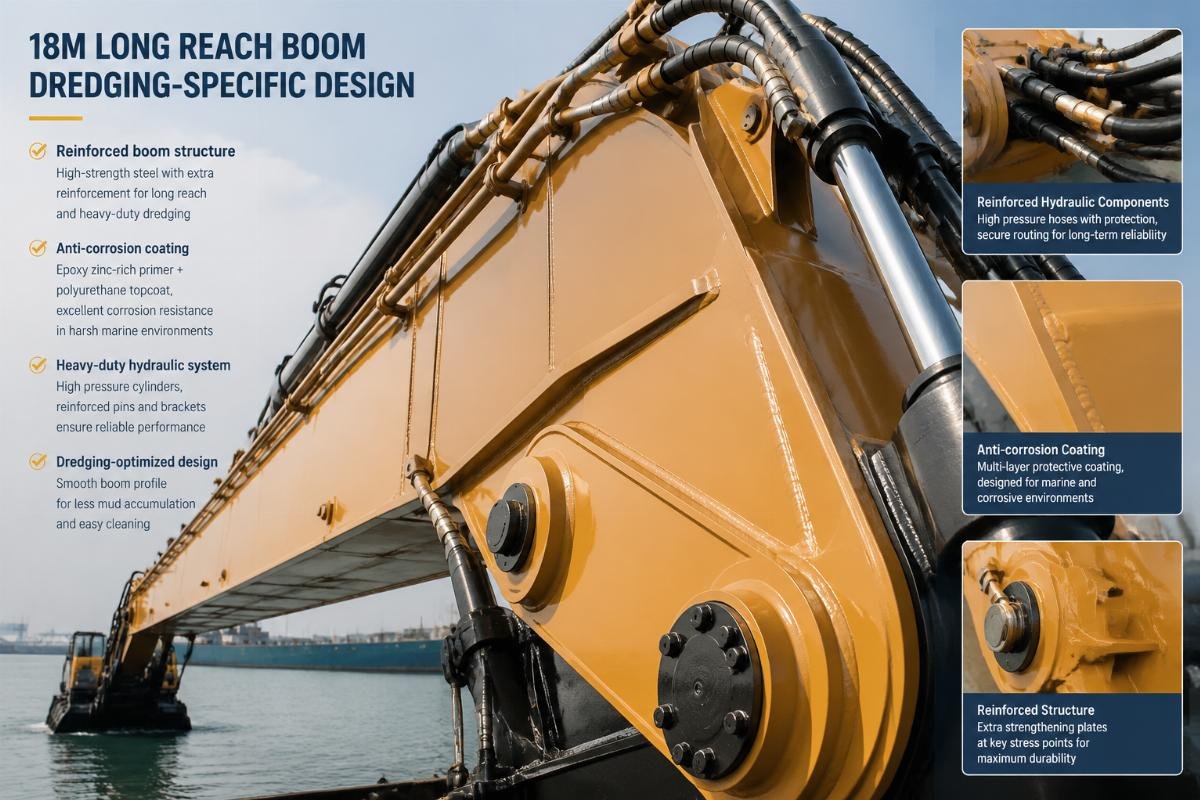
- Hydraulic System Audit – Confirm the supplier’s standard hydraulic system can support continuous operation at maximum boom reach without overheating.
- Corrosion Protection Check – Require full undercarriage and boom anti-corrosion coating as a standard inclusion for all dredging-bound units.
- Operator Feedback Integration – Consult with your on-site dredge operators to incorporate layout adjustments that reduce fatigue during long shifts.
How to avoid common pitfalls when sourcing long reach excavators for bulk projects?
Delayed spare parts access and lack of local after-sales support cause 60% of unplanned downtime for bulk dredging fleets. Many procurement teams focus exclusively on unit price and lead time, only discovering gaps in support infrastructure once equipment fails mid-project with no replacement parts available for weeks.
| Sourcing Step | Common Pitfall | Proactive Mitigation |
|---|---|---|
| After-Sales Support | Assume global coverage from all suppliers | Confirm spare parts warehouses in your target market before placing orders |
| Delivery Timelines | Accept generic lead time estimates | Lock in firm delivery dates with penalty clauses for delays in formal contracts |
| Warranty Coverage | Rely on 6-month limited warranty terms | Negotiate 12-month full unit warranty with lifetime technical support access |
A large infrastructure buyer for a Latin America port expansion project prioritized suppliers with local spare parts warehouses in their target region, cutting average downtime per equipment failure from 14 days to under 48 hours across their 18-unit long reach excavator fleet. [NEED_CITE: Local spare parts warehouse access reduces long reach excavator downtime by 85% for bulk project fleets]
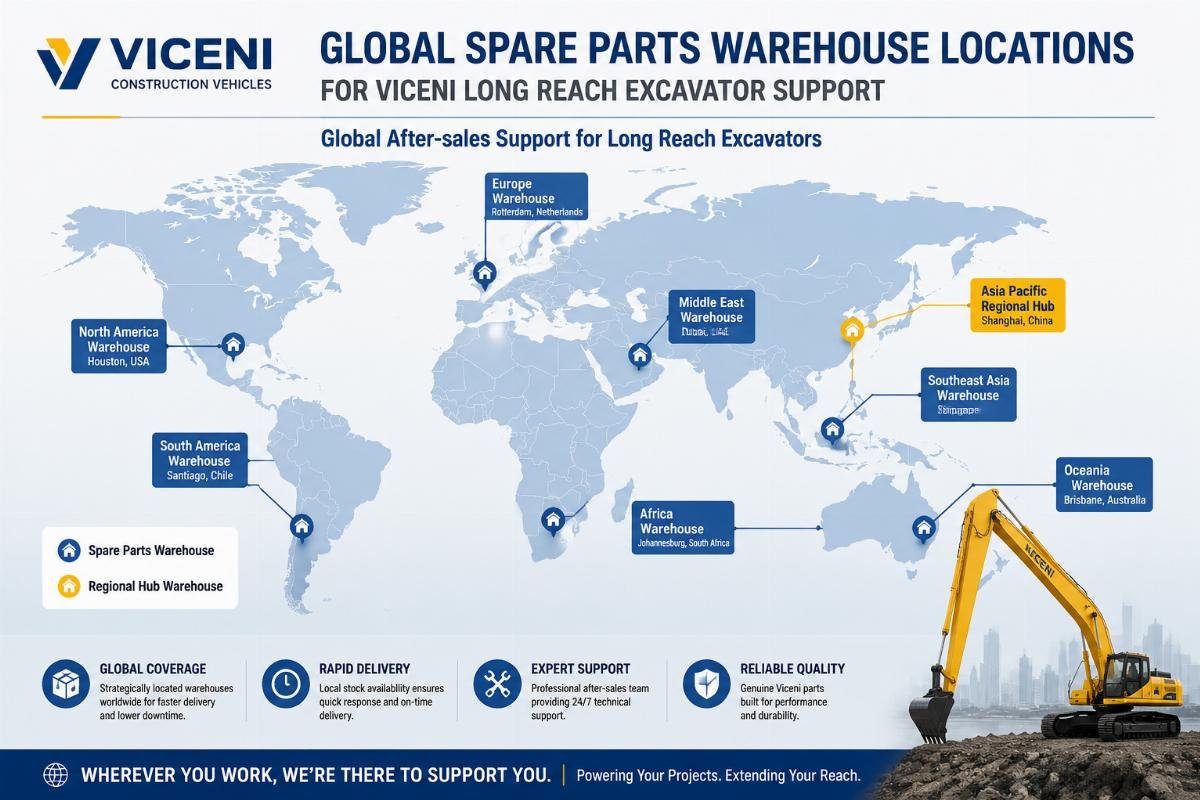
- Spare Parts Location Confirmation – Ask for physical address and stock lists for spare parts warehouses serving your project region before finalizing supplier selection.
- Lead Time Lock-In – Include firm delivery deadlines and late delivery compensation
